
Demos
Final-spec machines are now built up and firmware written - more demos coming soon.
Recordings are in chronological order, most recent at the top.
The most recent recordings were made testing a machine wth other instruments - didn't manage to make a video, but here's most of the set-up - we also used Nord drum pads:
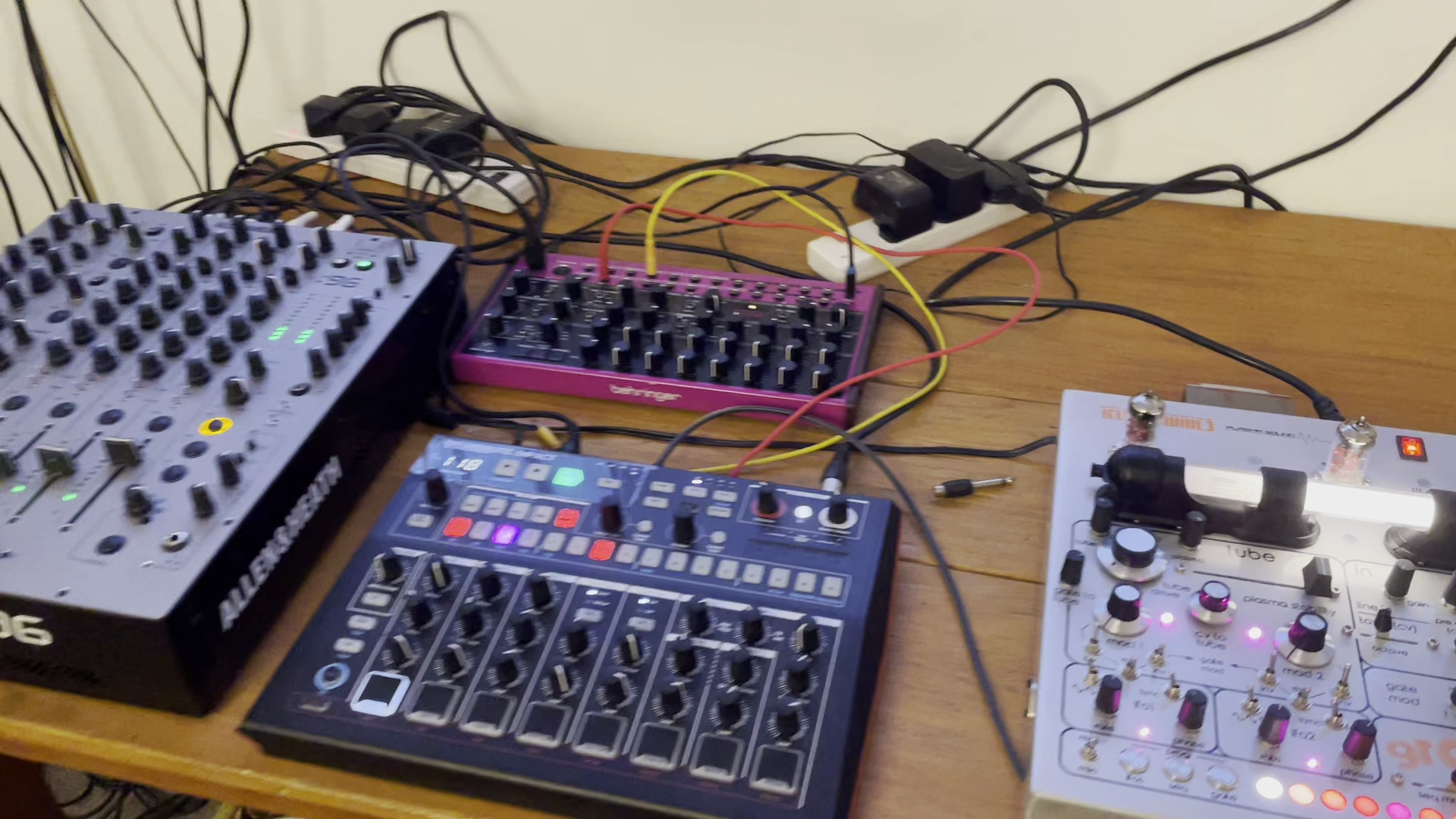
The session was recorded on separate tracks, so the synth can be isolated from the rest.
(Been trying to make a fancy player for this with a solo button... but for now the following clips are in pairs - one the full mix, and one just the synth track)
The synth was running Osram tubes in these.
1. Short clip, aiming for slow and atmospheric:
Full mix
Synth solo
2. A longer track - fast, and turned up to 11:
Full mix
Synth solo
Next one is the first video showing a production machine, running a Fusion brand fluorescent. It's a longer clip than most, seeing what sounds the tube can make:
WAV audio version 203 Mb download
Older clips below show working prototypes - testing run code and EQ settings, the line-in, and a couple showing oscilloscope traces of the input/output signals.
This one shows chaos-at-the-controls testing code for sequencer transport and octave switches:
Scope traces show the difference between signal input to the tube and audio output. Audio was recorded onto a laptop, so is better quality than in earlier demos.
High-quality audio version 54MB download
Versions of the following clips are also available with WAV audio, but with varying recording quality.
Plasma fluctuations can make some pretty crazy waveforms, like alternating long/short periods and repeating irregular patterns. In the clip below, tube drive is varied with each note, and you can see different types of waveform interacting with the input tones. Plasma has a volatile, non-linear response to drive conditions, so the system doesn't always produce quite the same result.
high-quality audio version 20MB
Next clips show line-in tests - in some the synth is running a Fusion brand fluorescent, in others a prototype neon tube. Fluorescents generally tend to add higher-frequency noise, and can produce a really brassy sound. The neon tube needs more voltage to produce much plasma noise, but run like this it adds warm distortion and definition to the sound, encouraging for the next versions.
We haven't tested many audio sources yet, but got good results with first sending a signal from radio or drum machine through a Wingie2 resonator. This boosts a narrow band of the input, and makes a compressed/saturated signal that the plasma responds well to - although the output level can vary significantly as the input spectrum changes.
Three clips showing live radio put through the resonator, and mixed with tones from the onboard synth oscillator before being sent to the tube.
high-quality audio version 57MB
The resonator initially distorts the radio signal, before the synth changes the sound again. In the next clips you can hear first the line-in signal and then the synth output, to show what the resonator is doing and what the synth is.
high-quality audio version 33MB
Two more clips, with the synth running in sync with a drum machine. The hi-hat signal is sent to the Wingie (short decay time on the first clip, long on the second), then into the synth line-in.
high-quality audio version 55MB
Older clips of previous machines are organised into two playlists on Youtube.
This one has a series of clips showing the machine operating alone, this one has clips of the synth being tested with drum machine and audio from live radio.