
Groovetube synth
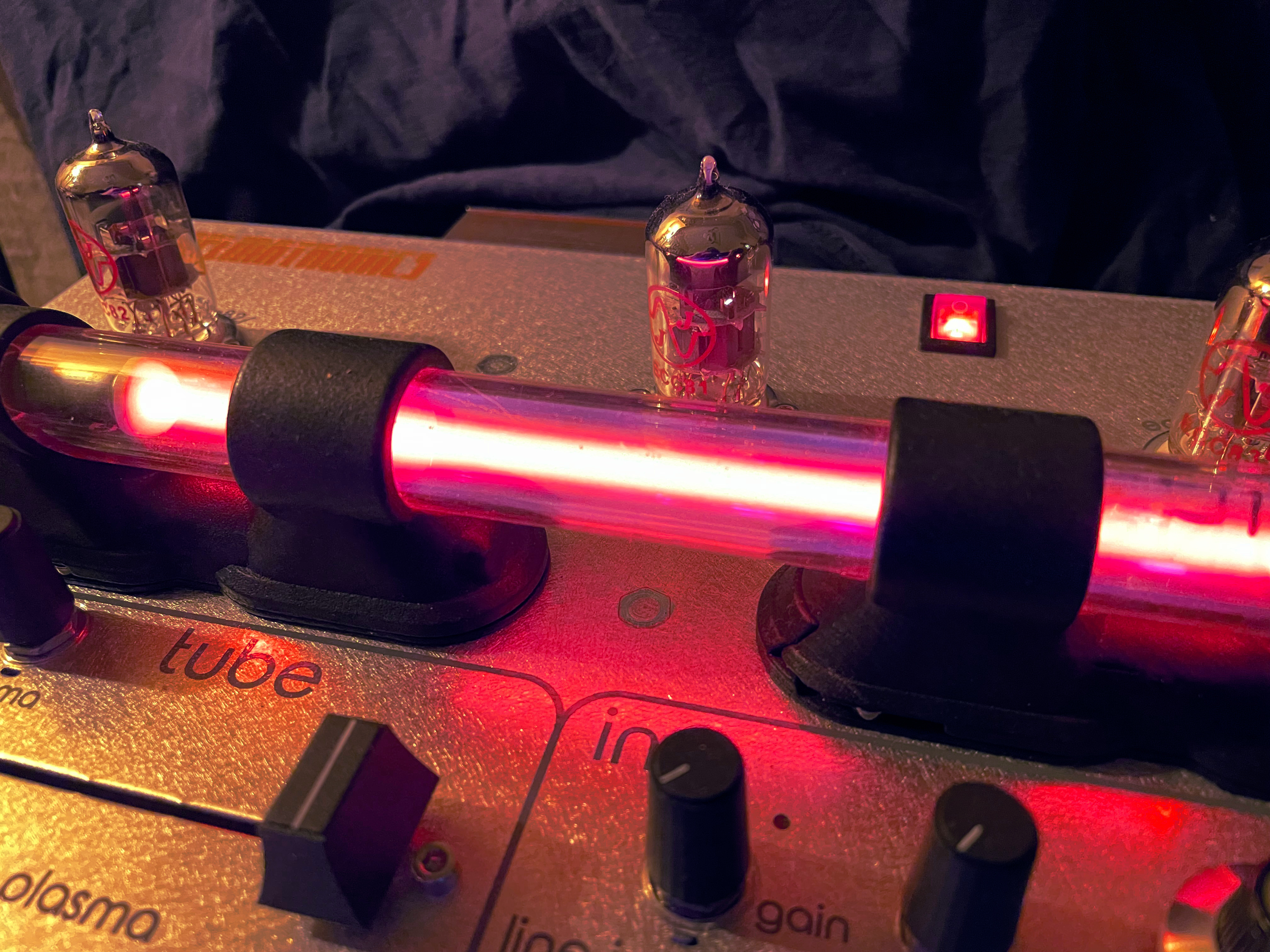
The Groovetube instrument is now pretty much complete.
It took ages to interface different parts of the circuit properly, and get all the signals working well on a pcb. The hardware development is now done, and the first batch of kickstarter machines is now built up - progress updates here.
We have a good idea of production costs, and will soon be able to take orders. The disappearance of fluorescent tubes is unhelpful - our supply is only enough for a few machines, and we won't be able to keep those machines running indefinitely. We may offer a short production run of fluorescent-tube machines, please get in touch if you are interested.
More significant production will have to wait until we are producing our own tubes, but we're gearing up to start work on these in earnest - watch for updates on that.
Overview
The synth works by exploiting the different sounds produced around the edge of plasma stability. It is like a valve pre-amp with a plasma tube in the current supply line, with a separate voice oscillator to create an input signal.
An input signal modulates voltage and current through the tube and its RF supply. This produces output sound as in a conventional amplifier, but the noise created as current passes through the tube interacts with and modifies the sound.
The noise boundary can be moved by either the RF stabilisation or with a magnet, and is also directly affected by the input level. Audio output is coupled directly from one end of the tube - there is no 'dry' or pass-through component.
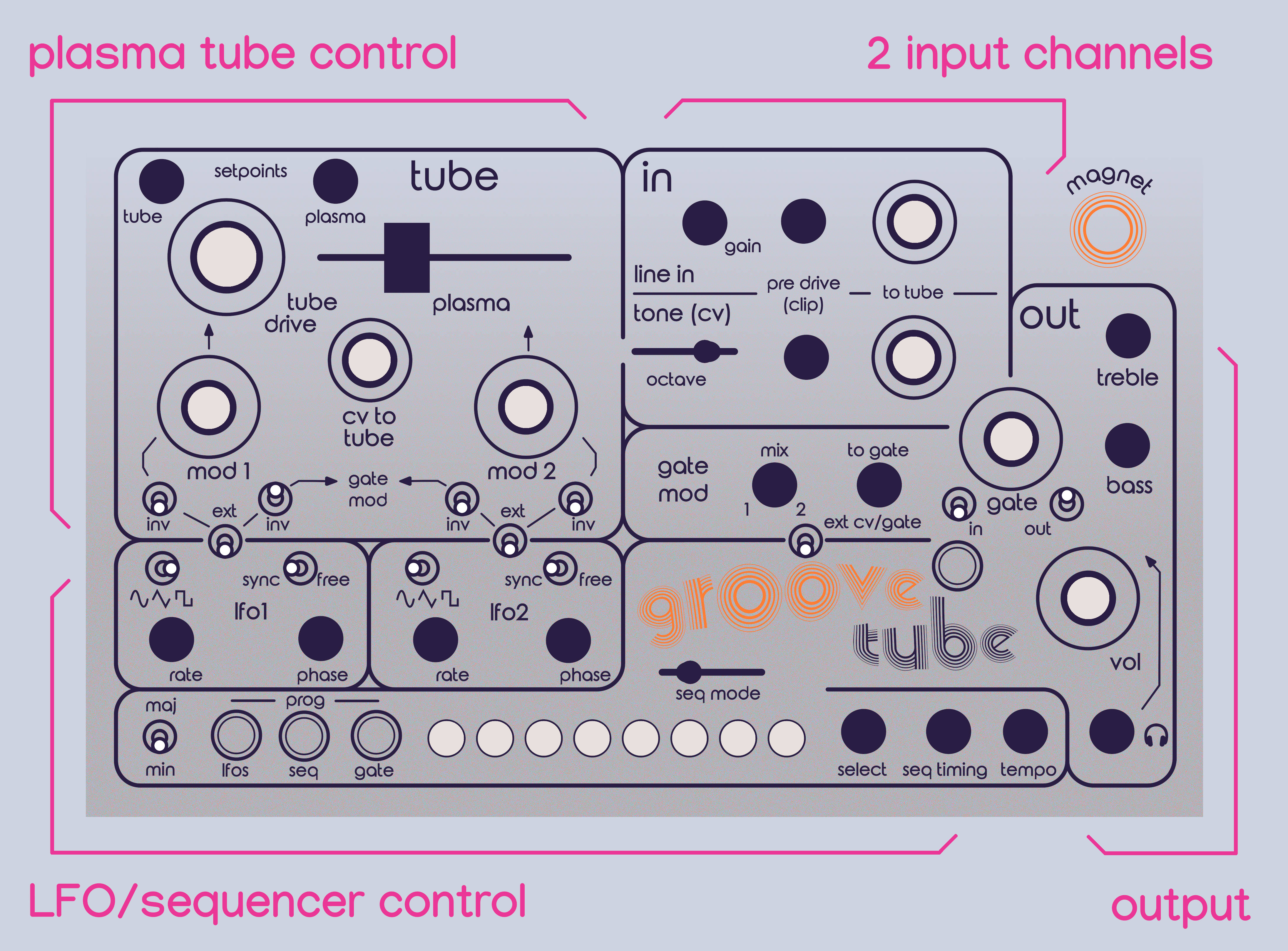
Two input channels are mixed down before being sent to the tube system. One of these is reserved for the tone generator, the other for audio line-in. Controls for input, plasma tube and output are grouped on the interface:
Demos
We now have final-spec machines built up, and the control firmware is mostly written.
Below are a few clips testing run code and EQ settings, the line-in, and a couple showing oscilloscope traces of the input/output signals.
All time is currently going towards getting the first few machines out into the world, more demos to come when possible.
The most recent recording is a longer clip, also the first showing a production machine (running a Fusion brand fluorescent):
WAV audio version 203 Mb downloadThe previous demo shows chaos-at-the-controls testing code for sequencer transport and octave switches:
Scope traces show the difference between signal input to the tube and audio output. Audio was recorded onto a laptop, so is better quality than in earlier demos.High-quality audio version 54MB download
Versions of the following clips are also available with WAV audio, but with varying recording quality.
Plasma fluctuations can make some pretty crazy waveforms, like alternating long/short periods and repeating irregular patterns. In the clip below, tube drive is varied with each note, and you can see different types of waveform interacting with the input tones. Plasma has a volatile, non-linear response to drive conditions, so the system doesn't always produce quite the same result.
high-quality audio version 20MBNext clips show line-in tests - in some the synth is running a Fusion brand fluorescent, in others a prototype neon tube. Fluorescents generally tend to add higher-frequency noise, and can produce a really brassy sound. The neon tube needs more voltage to produce much plasma noise, but run like this it adds warm distortion and definition to the sound, encouraging for the next versions.
We haven't tested many audio sources yet, but got good results with first sending a signal from radio or drum machine through a Wingie2 resonator. This boosts a narrow band of the input, and makes a compressed/saturated signal that the plasma responds well to - although the output level can vary significantly as the input spectrum changes.
Three clips showing live radio put through the resonator, and mixed with tones from the onboard synth oscillator before being sent to the tube.
high-quality audio version 57MB
The resonator initially distorts the radio signal, before the synth changes the sound again. In the next clips you can hear first the line-in signal and then the synth output, to show what the resonator is doing and what the synth is.
high-quality audio version 33MB
Two more clips, with the synth running in sync with a drum machine. The hi-hat signal is sent to the Wingie (short decay time on the first clip, long on the second), then into the synth line-in,
high-quality audio version 55MB
Older clips of previous machines are organised into two playlists on Youtube.
This one has a series of clips showing the machine operating alone, this one has clips of the synth being tested with drum machine and audio from live radio.
Tubes
Fluorescent tubes were a great resource to develop this machine, and seemed a fun way to open up plasma sound for experiment... but are fast becoming unavailable, and future production is now having to wait on us making our own tubes.
Fluorescents have in fact turned out to not be ideal - testing a lot more found them to be really variable. Common problems are noise that won't stabilise, and inconsistent operating range - likely due to the electrode thermionic coating, possibly the distribution of mercury in the tube. Many tubes seem to settle in after a few hours' operation, and a small magnet by the anode often stabilises excessive noise. We don't yet have a clear idea of the overall lifetime for fluorescents in this machine, but after 100+ hours tubes have become quieter as the electrode coating gets eroded and current drops.
We won't need to use coated electrodes or mercury in our tubes, so these will be more stable. Electrode shape is likely to be an important factor in determining the sound, as this will influence the sheath structure between plasma and electrode surface, where much of the noise seems to be produced. It will be exciting to find out what is possible.
Ordering
Cost
Our current cost estimate is £2,200, including:
- One Groovetube instrument in aluminium travel case
- One set of JJ valves
- Three fluorescent tubes- tested for good/different sound
The travel case, synth enclosure, pcb and transformer are all made in the UK, and the instruments will be assembled here too.
Production at any scale will have to wait until our custom plasma tubes become available.
If you are interested in one of these instruments, please feel free to contact us via telmatronics at gmail dot com, and we'll keep you updated on progress. All contact details are kept confidential.
We have always aimed to make kits/components/schematics/construction notes available for those wishing to build up their own machines - this will also have to wait for now. A basic schematic of the main circuit can be found here.
Specification
| Transformer | Can be supplied for any mains input. Standard model is configured for 110/120/220/230/240 VAC - please contact us if you require an alternative |
| System voltages | Valve circuit B+ : 370 VDC Control signals: 12 VDC Valve heaters: 6.3 VAC |
| Valves | ECC82 x 1, ECC81 x 1, ECC83 x 2 |
| Tube | 6 W T5 |
| Control signals | CV/gate - internal/external 0-5V 2 x LFO - internal/external 5V p-p Sync in/out - 48/1,2,24,48 ppb 5V |
| Audio | Line in, line out, headphones |
| System control | Arduino Due |
RF is delivered to the plasma using two coils. The tube can easily be changed, with interlocks incorporated in the housing.
Analogue audio path - the signal is routed from the tube anode to tone/EQ stages in the valve circuit, then through volume compensation and gate at lower voltage before being prepared for outputs.
The variable-depth gate can be applied to the synth voice signal before the tube and/or audio output.
Tempo is controlled by the synth or an external signal, with sync signal output for other equipment. The sync in rate is 48 ppb, sync out can be set to 48/24/2/1 ppb.
Onboard control uses a simple 8-step sequencer to run programmable CV sequences and gate patterns.
The twin LFOs are digitally-controlled for good control over frequency and phase. The analogue signals they produce can be applied to modulate tube voltage and plasma stability, and also to the gate signal.
A powerful Arduino Due board runs the machine, and plugs onto the accessible side of the pcb for easy removal. Using Arduino means we can easily send out code updates, and you can also write your own.